The science of copper — and how to verify it yourself.
People have stored water in copper for thousands of years. Here’s what actually happens at the surface of the metal, the 5-second test you can run at home, and the independent lab verification behind every batch.
How it works
What copper does in water
Copper ions release into the water
Stored in a solid copper vessel, a trace amount of copper ions slowly migrates into the water — the basis of the centuries-old practice.
Ions disrupt microbes on contact
Those copper ions interfere with microbes they touch. Scientists call it the oligodynamic effect — a well-documented property of the metal itself.
You drink water stored the Ayurvedic way
Fill it at night, drink in the morning — tamra jal, the copper-water ritual kept for thousands of years.
We describe a well-studied material property, not a treatment — we make no medical claims.
Authenticity, in 5 seconds
The magnet test
A lot of “pure copper” bottles sold online are steel, coated to read as the real thing. You can screen any of them in seconds.
Hold a magnet to the bottle
Press a small magnet against the bottom or side of any “copper” bottle — including ours.
Pure copper is non-magnetic
Solid copper won’t cling to a magnet. It simply slides off — nothing to grab onto.
If it grabs, it’s steel
A magnet that holds means there’s magnetic steel under the finish — coated or plated to look like copper.
The magnet is a quick screen, not a lab — some steels are only weakly magnetic. That’s why we don’t stop there: every batch is independently lab-tested for purity.
Proof, not promises
We send a sample from each batch to an independent lab.
Talk is cheap, so we don’t ask you to take our word for it. Every production batch is sampled and tested for purity by an independent lab — confirmed as solid copper, with no inner lining, no nickel, and no plating.
99.9%
Lab-verified pure
0
Magnets that stick
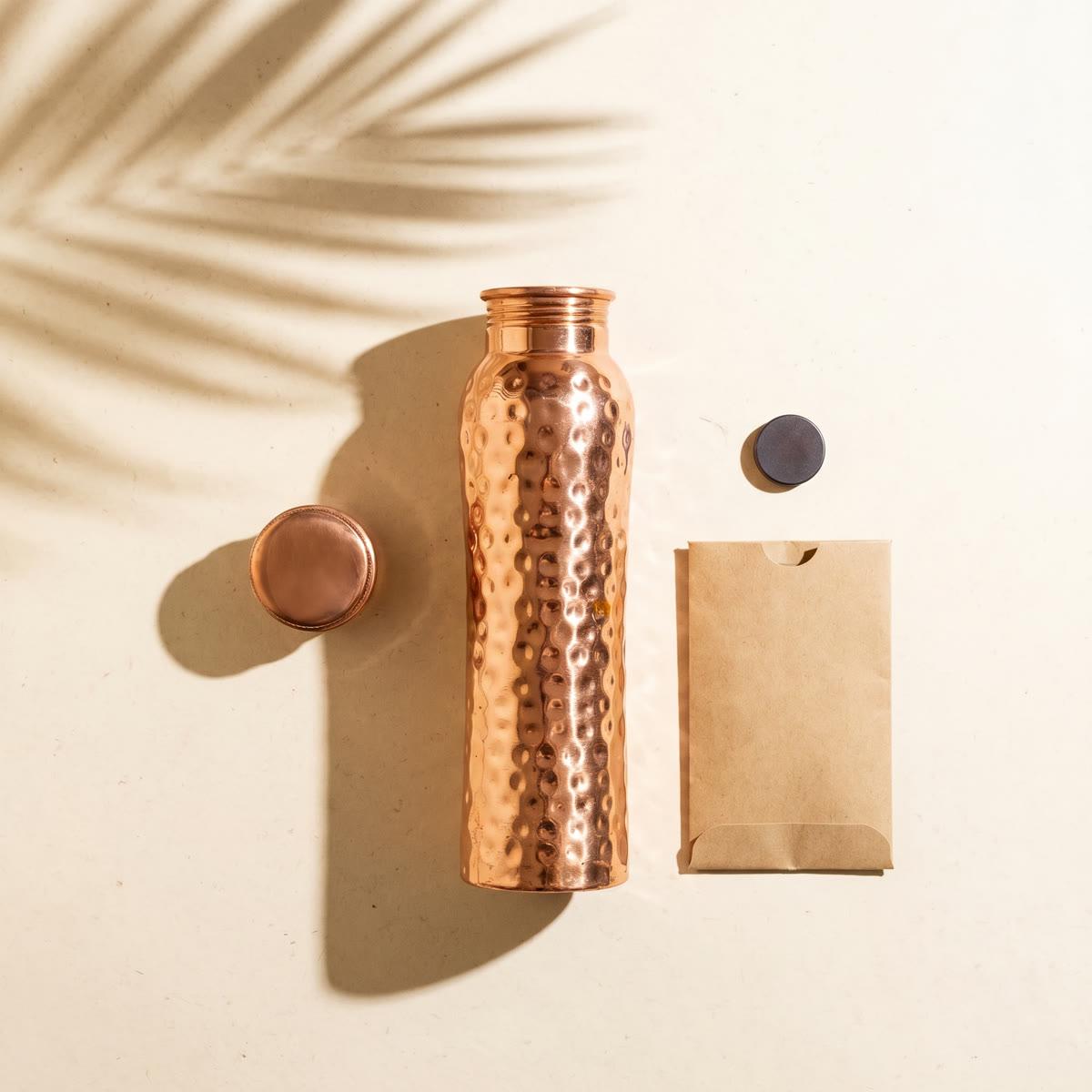
99.9% pure copper — lab-verified
Referenced, not embellished
What does the research actually say?
Copper’s effect on microbes is one of the better-documented properties of any metal — described in 1893, tested on drinking water in peer-reviewed studies, and recognized by the U.S. EPA. Here are the sources, so you can check them.
The oligodynamic effect is first described
Swiss botanist Karl Wilhelm von Nägeli documents that trace metal ions — copper among them — disrupt microbial cells at very low concentrations. The term « oligodynamic » (from the Greek for « small forces ») is his.
Copper pots vs. contaminated drinking water
Sudha et al., Journal of Health, Population and Nutrition: water inoculated with diarrhoeagenic bacteria (including V. cholerae, Shigella flexneri and enterotoxigenic E. coli) and stored 16 hours in copper pots at room temperature showed no recoverable bacteria on culture. Copper leached into the water at about 177 µg/L — well within the WHO drinking-water guideline of 2 mg/L.
U.S. EPA registers antimicrobial copper
Copper alloys become the first solid material granted a U.S. EPA public-health registration, recognizing that copper surfaces kill more than 99.9% of certain bacteria within two hours of contact. A property of the metal itself — the same metal this bottle is hammered from.
None of this turns a bottle into a medical device, and we don’t pretend it does. It’s a traditional practice built on a real material property — we sell the craft, and we verify the metal.
Questions people actually ask
Copper water, answered
How long should water sit in a copper bottle?
The traditional tamra jal practice is overnight — roughly 6 to 8 hours. For reference, the 2012 Journal of Health, Population and Nutrition study stored water 16 hours before testing. Fill the bottle at night, drink in the morning.
Is water stored in copper safe to drink?
In the 2012 study, 16 hours of storage leached about 177 µg/L of copper — under 10% of the WHO drinking-water guideline of 2 mg/L. Store plain water only: acidic drinks like lemon water or juice pull much more copper from the metal and don’t belong in a copper bottle.
Does a copper bottle stop working over time?
The metal doesn’t wear out, but tarnish — the natural oxide layer — builds up on the inner surface and reduces water-to-copper contact. A monthly rinse with lemon juice and salt restores the bare metal. See our copper care guide for the exact routine.
How can I tell real copper from coated steel?
Hold a magnet to it: solid copper is non-magnetic, so the magnet slides off. If it grabs, there is magnetic steel under the finish. The magnet is a 5-second screen, not a lab — which is why every Coppora batch is also independently lab-verified at 99.9% purity.
Real copper. Proven, not promised.
Drink from solid copper the way it’s been done for centuries — with a magnet to screen it and independent lab testing to back it.
Solid copper · Passes the magnet test · Lifetime guarantee